
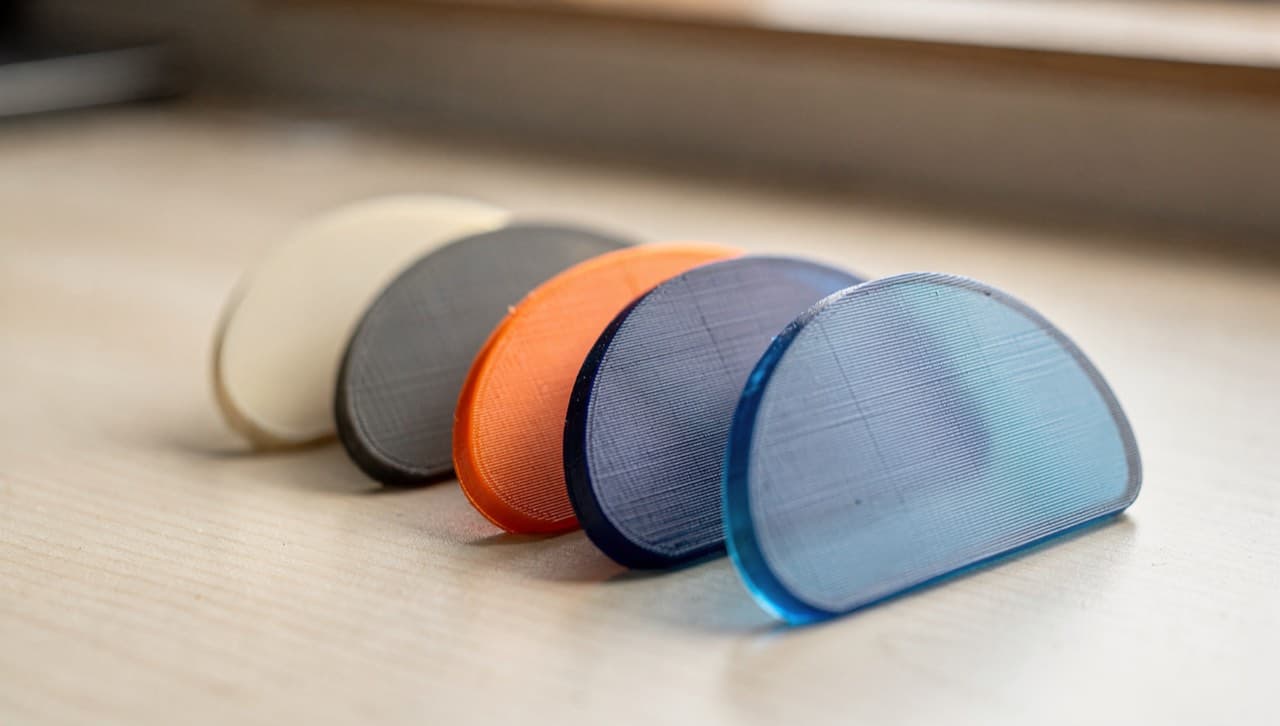
Colour and finish are the two choices customers most often go back and forth on, and they're worth getting right because they change how the object actually looks in your hand more than people expect. A 3D print is not a painted surface; the colour comes from the filament itself, and the layer lines interact with that colour and with light in ways a screen swatch can't show you. This guide is how we think about it in the workshop.
Colour reads differently on plastic than on screen
The first thing to know: the colour is true-to-spool, not true-to-screen. A filament colour almost always looks slightly more matte and a little less saturated in person than the swatch on your monitor, which is backlit and idealised. A "translucent blue" comes out looking like real tinted plastic, not a glowing Photoshop gradient. We pick spools from suppliers with decent colour consistency, but plan for "real plastic" rather than "screen render."
This isn't a downside once you expect it. Matte, slightly desaturated colours read as considered and physical, which suits the workshop aesthetic. It just means you should choose for the object, not for the swatch.
Layer lines, light, and how colour hides or shows them
Every FDM print has horizontal layer lines (0.2 mm by default on our Bambu A1 mini; the tolerance guide explains why). Colour and finish change how visible those lines are:
- Matte and lighter colours (cream, light grey, pastels) diffuse light and soften the appearance of layer lines. The surface reads smooth and even from a normal viewing distance.
- Glossy or dark saturated colours (deep blue, black, red) reflect light along each layer ridge, so the lines catch as fine horizontal highlights. On a decorative piece this can look deliberate and architectural; on a surface you want to read as seamless, it's more noticeable.
- Silk and metallic filaments have a sheen that emphasises layer lines further. They look striking on the right geometry (a faceted vase) and busy on the wrong one (a flat panel).
- Translucent colours let light travel a little into the part, which softens detail and gives depth, but also makes internal infill structure faintly visible. Beautiful on a vase, distracting on a part where you want a solid read.
If hiding layer lines matters more than colour, a matte light colour plus light sanding and sealing (see the finishing guide) gets you closest to a smooth surface.
Matte, glossy, silk, translucent: a quick map
| Finish | Looks like | Best for | Watch out for | |---|---|---|---| | Matte | Even, soft, low-reflection | Decor, desk items, anything you want to read clean | Shows fingerprints less; hides lines well | | Standard PLA | Slight sheen | General-purpose, most catalog items | Lines visible in raking light | | Silk / metallic | Pearlescent, reflective | Statement decorative pieces, faceted shapes | Emphasises layer lines on flat areas | | Translucent | Tinted, light passes through | Vases, light-adjacent decor | Infill faintly visible; less solid read |
Match the colour to the use, not just the taste
A few workshop heuristics:
- Functional and hidden parts (cable organisers, brackets, jigs): pick whatever's in stock. Colour is cosmetic here, so a stock colour keeps cost and lead time down.
- Desk and display items (vases, stands, coasters): matte neutrals (cream, charcoal, grey) age well and match most interiors. Our filament orange is the workshop accent if you want a pop.
- Items that mate with something (a phone stand for a specific phone, a coaster set): consider contrast or match with the object it sits beside, and remember the fit is set by the model, not the colour.
- Gifts and statement pieces: this is where silk, metallic, or translucent earn their place. The sheen reads as special.
Stock colours, and getting one we don't stock
Most catalog items come in 3 to 5 stock colours, listed on each product page; some ship as "assorted" mixes. The colour picker on the product page sets the filament for that order.
If you want a colour that isn't listed, don't try to force it through checkout. Send it through the custom intake instead, with a note like "the geometric vase in deep teal." We source filament locally (Sungai Buloh and Shopee MY; see where to buy filament in KL), so we can almost certainly get the colour, just not while you're sitting on the checkout page. Sourcing a non-stock spool typically adds a day or two to the lead time.
When you're not sure
If you can't decide, tell us the object and the room or context it's going into, and we'll recommend a colour and finish. We'd rather spend a message getting it right than have you open the box and wish you'd picked matte. For the full picture of what to expect when the print arrives, the first-time buyer guide walks through the physical object end to end.