
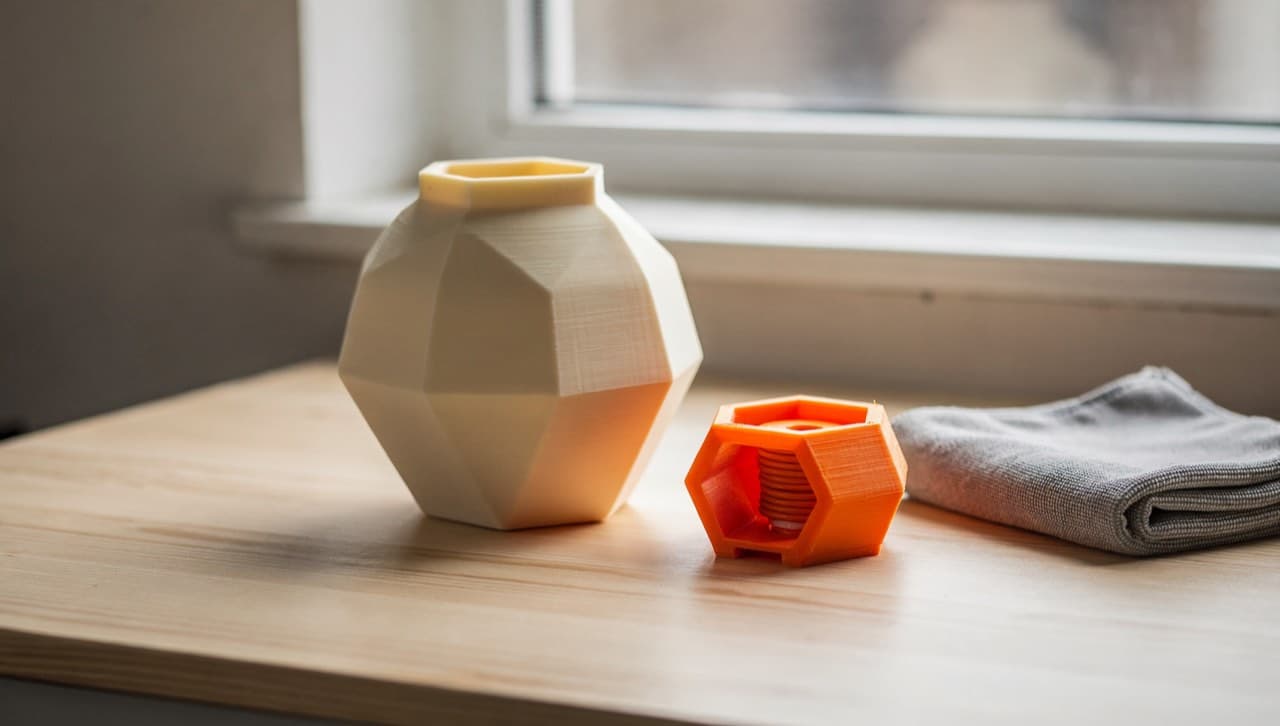
Most questions we get after delivery are some version of "how do I look after this?" The honest answer for the majority of our catalog is: not much. PLA is a stable, low-maintenance plastic at room temperature. But a printed object fails in a few specific, predictable ways, and almost all of them come down to heat. This guide covers what actually damages a print, how to clean one without scuffing it, and how long you can reasonably expect it to last.
Unless a product page says otherwise, assume your item is PLA. The advice below is organised by material at the end, but PLA is the default case.
The one thing that kills PLA prints: heat
PLA starts to soften at around 55 to 60 °C. That sounds high until you remember where everyday objects actually sit:
- A car dashboard or rear shelf on a sunny KL afternoon easily passes 60 °C. A PLA phone stand left in a parked car will droop and sag, sometimes within an hour. This is the single most common way a print gets ruined.
- A windowsill in direct afternoon sun can warm a dark-coloured print enough to deform it over time.
- On top of an appliance that vents heat (a router, an amplifier, the back of a fridge, a laptop charger brick) the slow warmth adds up.
The fix is simple: keep PLA out of hot cars and out of direct, sustained sunlight. Indoor daylight, a desk, a shelf, a kitchen counter away from the hob: all fine. If you need an item that lives in a car or outdoors, tell us at order time and we'll print it in PETG, which holds its shape to around 80 °C. See the materials guide for the full heat-resistance comparison.
UV and the slow fade
Sunlight does a second, slower thing: it fades colour and, over months of direct exposure, makes PLA slightly brittle. Indoors this is a non-issue. For a print that lives on a balcony, a window ledge, or outdoors, PETG holds up better, and a coat of UV-resistant sealer (see the finishing guide) buys more time. We'll flag this on any custom job that's headed outside.
Cleaning a layer-lined surface
FDM prints have visible horizontal layer lines, which are tiny grooves that hold dust and grime more than a smooth injection-moulded surface does. Cleaning is easy as long as you respect two limits: no high heat, and no aggressive solvents.
For everyday dust and fingerprints:
- A dry or slightly damp microfibre cloth handles most of it.
- For stuck-on grime, lukewarm water with a drop of dish soap, then wipe and air-dry. Lukewarm, not hot.
- An old soft toothbrush gets into the layer grooves and around fine detail without scratching.
What to avoid:
- Hot water or a dishwasher. The drying cycle alone can warm PLA past its softening point. Hand-wash in lukewarm water only.
- Acetone, thinners, and harsh solvents. Acetone will etch and cloud PLA and PETG. (It smooths ABS, which we don't print.) Isopropyl alcohol is fine for a quick wipe but don't soak the part.
- Abrasive scourers on a finished surface. They cut through the layer sheen and leave dull patches.
If your item was sanded and sealed before it shipped, the sealer is the wearing surface; a gentle wipe keeps it looking right for a long time.
Mechanical care for moving and mating parts
Some catalog items have moving joints (the articulated dragon) or mate with another object (a phone stand, a cable organiser, a coaster). A few habits keep them working:
- Don't force a stiff joint. Print-in-place joints loosen with gentle back-and-forth use. Forcing one can shear the thin connecting layer.
- Expect a friction fit to wear in, not out. A snug phone stand or cable clip is sized to grip; it gets slightly easier over the first few uses and then stays put.
- Re-seat, don't glue. If a part feels loose, check it's seated correctly before reaching for adhesive. If you do need glue, cyanoacrylate (super glue) bonds PLA and PETG well; avoid solvent-based glues.
How long does a 3D print actually last?
Set indoors, away from heat and sun, a PLA print is stable for years. It does not biodegrade on a shelf despite being plant-derived; that only happens under industrial composting conditions. The realistic failure modes, in order of likelihood:
- Heat deformation from a hot car or direct sun (preventable, see above).
- Mechanical stress on a thin or load-bearing feature over time. PLA is stiff but not very impact-tough; a print dropped on a hard floor can crack at a stress point.
- UV embrittlement after long outdoor exposure (months).
None of these is a wear-out clock. A coaster, a vase, an organiser kept in normal indoor conditions will outlast your interest in it. If something does fail and it looks like a print defect rather than an accident, email us at /contact; we stand behind the work.
Care by material, in one table
| Material | Softens around | Outdoor / car | Cleaning | Typical use | |---|---|---|---|---| | PLA (default) | 55 to 60 °C | Avoid | Lukewarm water, mild soap | Decor, desk items, indoor parts | | PETG | ~80 °C | Tolerates better | Lukewarm water, mild soap | Functional, semi-outdoor, near-warmth | | TPU (flexible) | ~80 °C | Tolerates | Lukewarm water; flex won't crack | Grips, bumpers, flexible parts |
If you're not sure which material your item is, the product page lists it in the spec table, or you can ask via /contact with your order number.
The short version
Keep it out of hot cars and direct sun, wipe it with lukewarm water and a soft cloth, skip the dishwasher and the solvents, and it will last for years. If you need something that breaks those rules (lives outdoors, sits near heat, takes real mechanical load), that's a good reason to start a custom quote so we can pick the right material before we print.