
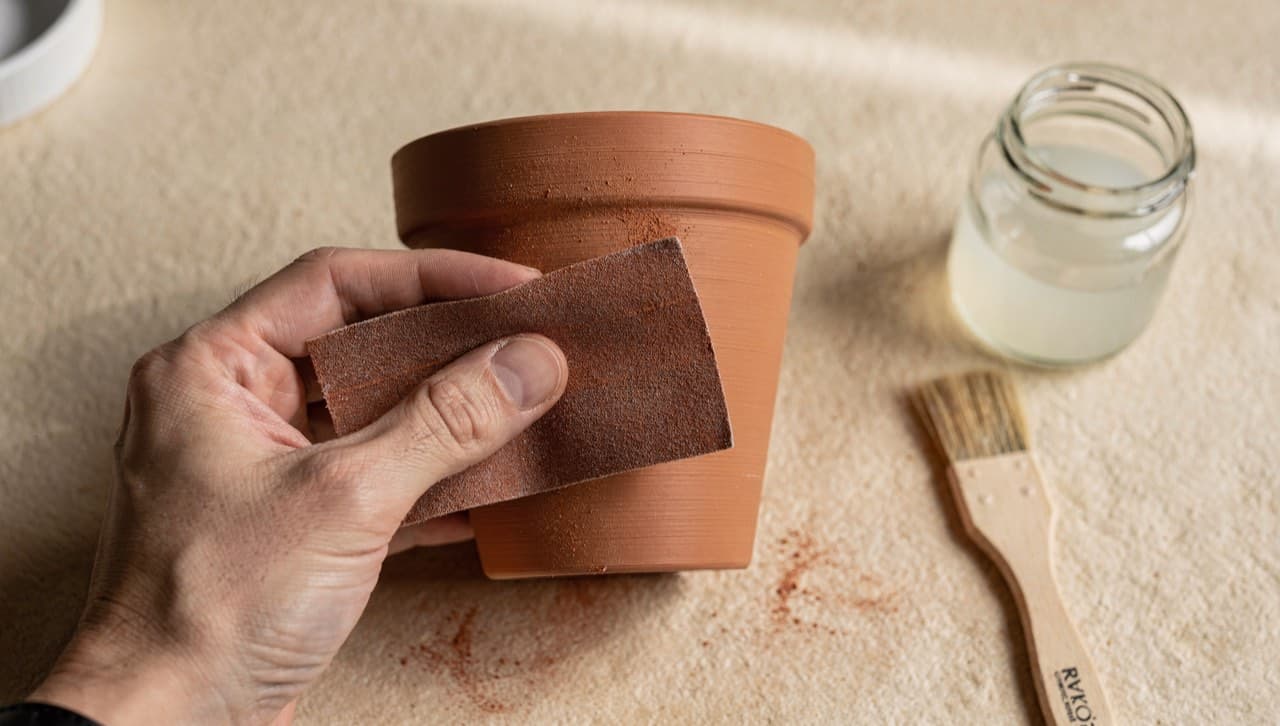
Every FDM print comes off the bed with visible layer lines. For most catalog items that's fine — the lines are a feature of the process, and the design accounts for them. For a few items (food-adjacent surfaces, gift pieces, anything that gets handled often) you want a finishing pass. This guide covers what we do, what we don't, and the surprisingly subtle answer to "is a 3D-printed coaster food-safe?"
It's the longest guide on the site by word count because finishing decisions involve health questions, and we'd rather over-explain than under-disclose.
What "finish" means on a 3D print
An FDM print's surface texture comes from two things:
- Layer lines — the horizontal banding from each 0.2 mm layer. Most visible on side walls, less visible on top/bottom surfaces (which are extruded as continuous skins).
- Print-bed texture — whatever the bottom face was printed against. Smooth PEI sheets give a glossy finish; textured PEI gives a fine matte texture. We use textured PEI by default.
A "finished" print has had either or both reduced. The options, in order of effort:
| Treatment | What it does | When we apply | |---|---|---| | Light sand (400 grit) | Knocks down printing artefacts at layer transitions | Most catalog items, ~30 sec per piece | | Progressive sand (400 → 800 → 1200) | Removes visible layer lines on critical surfaces | Custom requests, gift pieces | | Vapour smoothing | Chemically melts the surface for a glossy finish | Not offered (ABS-only, we don't run ABS) | | Primer + paint | Full opaque coating, hides everything | Custom requests; quoted separately | | Sealer (food-grade matte) | Seals porosity, slight protection from water | Coasters, decor that contacts moisture |
For catalog items, the default is a light 400-grit pass plus sealer on the coaster line (Mt Kinabalu). For custom orders, the finish is part of the quote — ask in the brief.
Sanding, in practice
Sanding FDM prints is straightforward, but a few things matter:
- Always sand dry. Wet-sanding clogs the paper fast on PLA. Save wet-sanding for the final 1200-grit polish if you're going that fine.
- Use a backer. A flat sanding block (or a credit card wrapped in sandpaper) keeps the sanding pressure even and stops you from rounding off edges you wanted sharp.
- Sand perpendicular to the layer lines. Working at 90° to the grain cuts down the high points faster than parallel.
- 400 grit is the workshop default. It knocks down layer lines without removing too much material. 220 grit is too aggressive; 600 grit is too slow.
- Don't overheat the surface. PLA softens at 55 °C; aggressive sanding generates enough friction heat to soften the top layer and make the print fuzzy. Light pressure, long strokes.
For a 100 mm × 100 mm flat surface, a full sand pass takes ~3 minutes by hand. We do this on the Mt Kinabalu coaster side walls but not the terrain-relief top surface — sanding the terrain side would flatten the very features that make it worth buying.
Sealing: what it actually does
A "sealer" is a thin polymer coating brushed or sprayed onto a finished print. Two reasons we apply one:
- Closes the porosity. FDM prints aren't truly solid — there are micro-gaps between layers. A sealer fills those gaps, which matters if the part will touch moisture (a coaster under a sweating glass, a planter that holds wet soil).
- Strengthens the surface. A sealed PLA print is slightly less prone to surface scratching during shipping and handling.
The sealer we use for food-adjacent items is MinWax Polycrylic Matte (water-based, low-VOC, food-grade-certified for cured cookware contact). One thin coat brushed on, allowed to cure for 24 hours, then a second coat if the surface still feels porous. Total per coaster: about 4 minutes of active work plus the cure time.
We don't seal items that don't need it. A phone stand doesn't need sealing — adds cost without benefit. A coaster does.
The food-safety question, honestly
This is the question that gets the most pushback when we answer it, so we'll answer it carefully.
Are 3D-printed coasters food-safe?
Short answer: They're food-adjacent, not food-safe. We seal them with a food-grade matte sealer so they're safe under a glass of water, a coffee cup, or a cold drink. We do not claim they are safe for direct food contact — you wouldn't eat off one or rest a raw oyster on one.
Long answer:
The food-safety problem with FDM prints comes from three sources:
- Layer lines harbour bacteria. The micro-gaps between layers create surfaces that can't be reliably cleaned. Even with sealer, the geometry isn't smooth enough to qualify as food-safe by FDA or EU food-contact standards. (Injection-moulded plastics, by contrast, have a continuous surface; that's why your Tupperware is rated and a 3D-printed Tupperware-shape isn't.)
- Filament additives may not be food-grade. Even "PLA from cornstarch" filament includes colorants, modifiers, and processing aids that aren't certified for food contact. PolyTerra PLA, our default, makes no food-contact claim.
- Heat exposure during printing changes the polymer chemistry. PLA extruded at 210 °C and rapidly cooled has different surface chemistry than PLA pellets straight from the bag.
A sealer mitigates problem 1 (smooths the surface) but doesn't address problems 2 or 3. That's why we say "food-adjacent" — the sealed coaster is safe under a glass, but the coaster itself isn't a food substrate.
What this means in practice:
- ✅ Use our coasters under glasses, mugs, plates, bottles. Sealed surface won't absorb condensation; no food contact.
- ✅ Use 3D-printed packaging (boxes, sleeves, gift containers) around food that's in its own wrapper.
- ❌ Don't use 3D-printed objects as plates, cutting boards, drink containers, or anything that holds food directly.
- ❌ Don't put 3D-printed parts in a dishwasher (PLA softens; sealer can lift).
For a properly food-safe object, the right material is injection-moulded plastic, silicone, glass, or food-grade stainless steel. We can print a prototype of a food-contact object for design validation, but the production version should be a different process.
Other finishes we sometimes do
A short list of custom-order finishes we offer:
- Acrylic primer + spray paint for opaque colours not available as filament. Quoted at +RM15–30 per piece depending on coverage area.
- Glass-bead blasting for an even matte texture across the whole part. Quoted at +RM10 per piece.
- Brass insert installation for threaded fasteners (M3 heat-set inserts). Quoted per insert.
- Hand-rubbed wax finish for warm-handled aesthetic pieces. Quoted on request.
Vapour smoothing, electroplating, and SLA-style polish-to-gloss are not offered — they need either a different printer or a different process. If your job needs a perfect glossy finish, FDM is probably not the right process; ask in the custom-quote brief and we'll be honest.
What's in your hand after a finish pass
A finished FDM print should:
- Feel smooth to a slow fingertip drag (no catching on layer transitions)
- Show no visible banding under indoor light at normal viewing distance
- Be uniformly coloured (no shiny patches where the sealer pooled)
- Have a slight matte sheen if sealed, or a soft eggshell if just sanded
If you receive a piece from us and it doesn't pass that check, that's a finish failure and we'll re-finish or refund. The /returns policy covers the process. The threshold isn't "perfect" — FDM is FDM — but it is "as good as we can make it without changing the process entirely."