
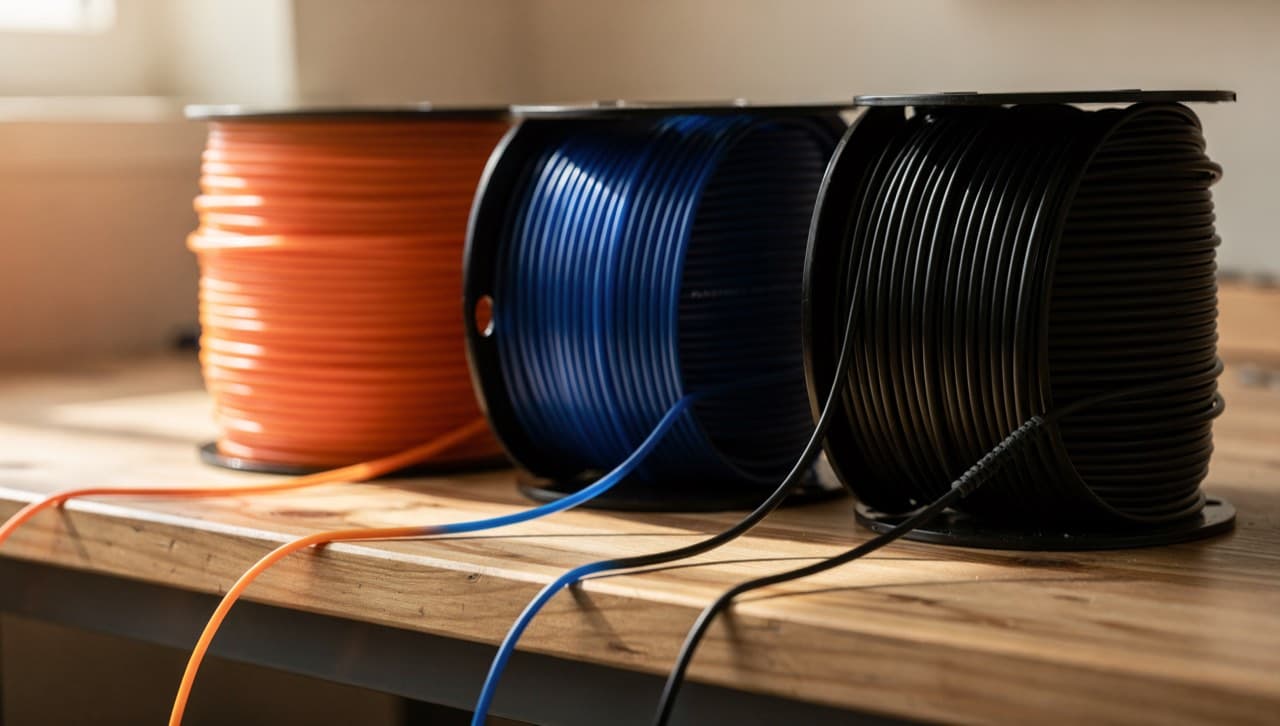
Walk into any 3D-printing material section in Malaysia — Shopee, the suppliers in Sungai Buloh, the small shops in Penang — and you'll see a wall of PLA in 30 colours next to a smaller section of PETG and a still smaller corner of TPU. That ratio reflects what most workshops actually run, ours included. Below is what we've learned from running each one in a tropical, mostly air-conditioned, occasionally very humid working environment.
We'll cover three materials in order of how often we print them: PLA, PETG, TPU. We'll also note when none of these is the right answer and you should be asking a different question.
PLA — the default, and that's a good thing
PLA is the cornstarch-based filament most workshops default to, and there's a reason: it's the easiest to print, it smells faintly sweet rather than chemical, and it's biodegradable on industrial-compost timescales. It is also where almost every catalog item we sell starts.
What PLA is good for:
- Decor, gifts, desk objects. Anything that lives indoors at room temperature.
- Visual prototypes — does this thing have the shape I want?
- Print-in-place mechanisms like the articulated dragon. PLA's stiffness is exactly what those joints need.
- Anything where the colour and finish are part of the value. PLA accepts pigments well, so the bright greens and translucent blues you see in our catalog are PLA.
What PLA is bad for:
- Anything that will see direct Malaysian sunlight for hours. PLA softens above ~55 °C, and the inside of a car in KL hits 60 °C+ on a sunny afternoon. We've watched a PLA phone stand droop on a dashboard. Don't trust PLA on anything that lives in a car or unshaded balcony.
- Outdoor parts. UV degrades PLA over months. By six months in direct sun it's brittle.
- Parts under sustained load. PLA "creeps" — it slowly deforms under continuous pressure, even at room temperature. A PLA bracket holding up a shelf will sag by year two.
- Anything snap-fit that gets flexed repeatedly. PLA is stiff but not tough. After ~20 cycles of being snapped open and closed, the hinge cracks.
Where we buy: Sungai Buloh has the closest spool warehouses. Eryone, eSUN, Polymaker are all in stock. Online, we use Shopee for one-off colours and direct-from-supplier for bulk. We avoid the absolute-cheapest PLA — it tends to be inconsistent in diameter (1.75 ±0.05 mm matters), which leads to under-extrusion and rough top surfaces.
Storage: Malaysian humidity is the enemy. Open spools left out for a month absorb enough moisture to pop and steam during printing — you'll hear it as a faint tk-tk-tk and see strings on the part. We keep working spools in a dry-box with silica gel; the rest live in their original vacuum bags. The whole workshop kit costs about RM 50.
PETG — when PLA isn't enough
PETG is PET's printable cousin (same family as water bottles), and it does the job when PLA can't. We use it for any part that will see heat, sustained load, or some flex.
What PETG is good for:
- Outdoor parts. UV-stable enough to last a year in direct sun, water-resistant enough to be left in rain.
- Heat-tolerant parts up to ~80 °C. The car-dashboard test PLA fails, PETG passes.
- Parts that need a little give. PETG bends before it breaks; PLA cracks.
- Snap-fits that get flexed regularly. PETG's hinge fatigue life is roughly 5× PLA's.
- Anything food-adjacent. PETG isn't certified food-safe out of an FDM printer — layer lines harbour bacteria — but if you seal it with a food-grade matte sealer, it's the right substrate to start from. We do not claim our PETG prints are food-safe; we say "food-adjacent" and we mean it.
What PETG is harder about:
- Stringing. PETG's softer flow means the filament drips between travel moves. We tune retraction more carefully and live with slightly fuzzier surfaces.
- Bed adhesion the other way. PETG sticks too well to PEI build plates. We use a glue-stick release layer to keep the plate alive.
- Cost. ~50% more expensive than PLA per spool in Malaysia.
Where we buy: Same suppliers as PLA — Polymaker's PETG is what we run most. Avoid the cheapest end here too; bad PETG cooks rather than melts.
TPU — when you need it to bend
TPU is the flexible one. It's rubbery enough to make phone cases, gaskets, and replacement watch straps; firm enough not to fold under its own weight. We run it less often than PLA or PETG because it's slower to print and harder to dial in, but for the right job nothing else works.
What TPU is good for:
- Phone cases and protective sleeves.
- Replacement rubber feet for laptops, appliances, furniture.
- Gaskets and seals.
- Drone parts that need to absorb impact.
- Any "soft handle" wrapping that a rigid material would crack.
What TPU is harder about:
- Print speed. We print TPU at 25-30 mm/s vs 80-150 mm/s for PLA. A small case takes 90 minutes instead of 25.
- Bridging. TPU droops badly on overhangs > 30°. Design accordingly.
- Detail. Sharp corners and thin features come out softer-edged than in PLA.
- The hardness matters. TPU comes in shore-hardness ratings — 85A is rubbery, 95A is stiff-rubbery, 98A is almost rigid. We default to 95A; ask in the custom-order brief if you need softer.
Where we buy: SUNLU and PolyFlex are both reliable in Malaysia. We don't buy the cheap end here — bad TPU clogs the extruder.
When none of these is the right answer
A few things FDM doesn't do well, regardless of which filament you pick:
- Tight tolerance parts (±0.05 mm). Look at SLA resin or CNC.
- Truly food-safe contact. Even sealed FDM prints aren't a long-term food substrate. Use injection-moulded products or food-grade silicone.
- Engineering parts above ~110 °C continuous. PETG is the ceiling of our shop; you'd want ABS, PC, or PEEK — different printers.
- Optically clear parts. No FDM material gives true clarity. Resin again.
- High-strength structural parts. Layer-line shear weakness limits FDM in tension. CFRP / aluminium / steel each have their own argument here.
The honest framing is: PLA covers about 70% of what walks through our door, PETG covers 20%, TPU covers 5%, and the last 5% we either price up significantly (for the patience required) or politely send to a different process.
If you're not sure which filament suits your job, sketch the use case in the custom-quote form and we'll tell you which we'd run, and why. No upsell — if PLA does the job, that's what we'll quote.