
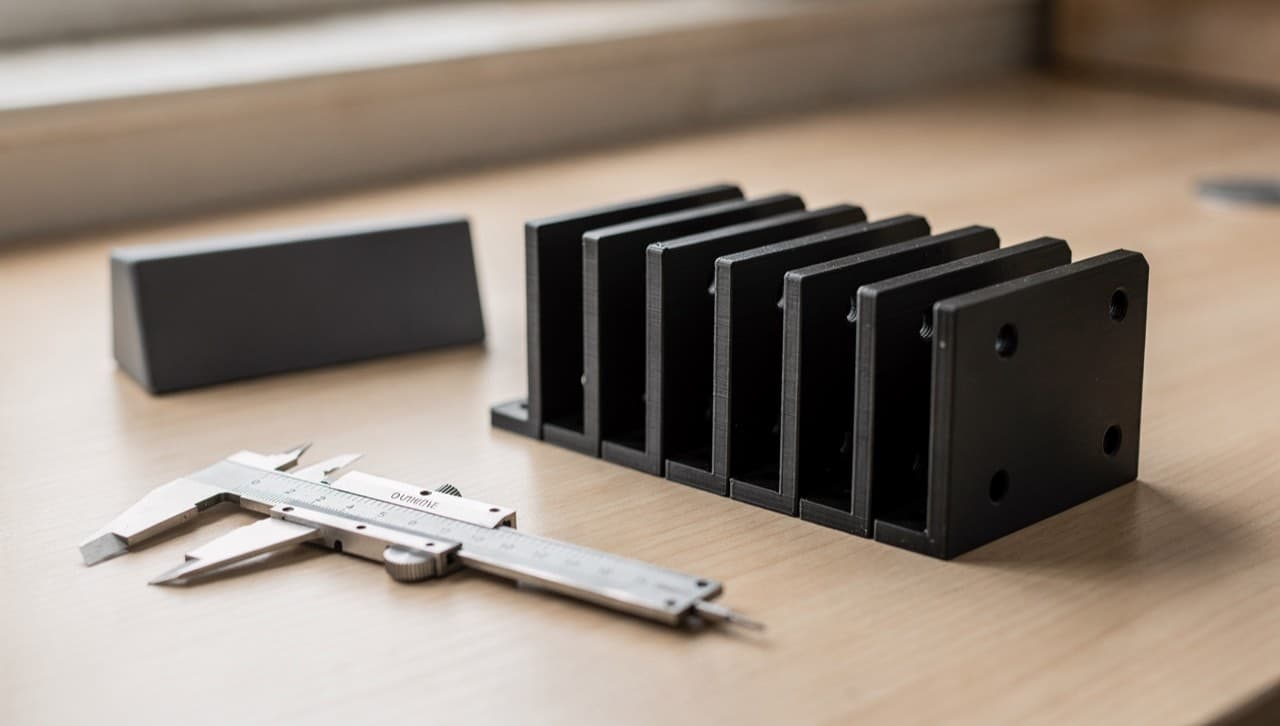
A fair share of our custom work comes from businesses, not hobbyists: a startup that needs ten enclosure prototypes before committing to a mould, a cafe that wants branded menu stands, a workshop that needs a one-off jig to hold a part during assembly. FDM 3D printing is genuinely useful for small-batch and bespoke work in ways that injection moulding and machining can't match at low volume. It's also wrong for some jobs. This guide is an honest map of which is which, written for someone evaluating us as a supplier.
We're a single-printer specialist workshop in Kuala Lumpur (a Bambu A1 mini, 0.4 mm nozzle, 0.2 mm default layer height). That shapes what we can take on, so the limits below are real, not boilerplate.
What FDM is genuinely good for
- Prototypes and design iterations. When you need to hold a part, check fit, and revise, FDM turns a CAD file into a physical object in days for a few ringgit of material. Iterate the design, reprint, repeat. This is the highest-value use: it's cheap to be wrong.
- Jigs, fixtures, and tooling aids. Custom holders, alignment guides, drilling templates, assembly fixtures. These don't need to be pretty, they need to be the right shape, and a printed jig costs a fraction of a machined one.
- Short production runs. Anything from 1 to roughly 50 identical units. Branded coasters, cable management for an office fit-out, replacement knobs, spare clips, display stands.
- Branded and bespoke physical items. Nameplates, logo stands, trade-show pieces, packaging mock-ups, custom desk accessories. We can model from a brief or print from your file.
- Discontinued or hard-to-source parts. A broken plastic clip on a piece of equipment, a knob nobody stocks anymore. If you can describe or measure it, we can often reproduce it.
What FDM is not for
We turn these away rather than disappoint you on delivery:
- High-precision engineering tolerance. Our working tolerance is ±0.3 mm. If your part needs better than ±0.05 mm, you want SLA resin or CNC machining, not FDM. See the tolerance guide for the engineering reason.
- Volume above ~50 units. One printer can do it, but slowly. For hundreds or thousands of identical parts, a print farm or an injection mould will be cheaper per unit and faster overall. We'll say so and point you in the right direction.
- Food-contact items. FDM layer lines harbour bacteria and sealing only goes so far. We can quote food-adjacent (sealed display pieces, packaging mock-ups) but not anything you'd eat or drink from. The finishing guide covers where we draw that line.
- High-heat or structural load-bearing parts in PLA. For warmth or stress we'll quote PETG; for serious mechanical load FDM may not be the right process at all.
Lead time and pricing, realistically
Custom orders move through the custom intake, and we reply within one working day with a material recommendation, lead time, per-unit price, and total. A few things to set expectations:
- Lead time is production plus shipping. A small job (a handful of parts) is typically 2 to 5 working days of production, then 2 to 4 days courier within Malaysia. A larger batch or one that needs modelling from scratch adds time, which we quote up front.
- Per-unit price drops with quantity. A batch of identical parts is cheaper per unit than a one-off, because the setup (slicing, orientation, test fit) is amortised. Tell us the quantity and we'll quote the batch rate.
- Modelling time is quoted separately. If you send a ready file, you skip this. If we model from a sketch or brief, the design time is a line item, confirmed before we start.
- Once printing starts, custom orders are non-refundable. We always confirm the quote, material, and (where relevant) a proof before filament hits the bed, so there are no surprises.
What to send us
The more you send, the tighter the quote. In rough order of usefulness:
- A 3D file, if you have one. We accept STL, OBJ, 3MF, and STEP, up to 50 MB. This is the fastest path to an accurate quote.
- Dimensions and a sketch or photo. For a part we'll model, a dimensioned sketch or a photo with a ruler in frame is enough to start.
- Quantity and deadline. Both affect the quote materially. If there's a hard date, say so.
- The use case. Telling us a part is a load-bearing bracket versus a display piece changes the material and orientation we recommend. Context helps us print it right the first time.
- Colour and finish, if it matters. We stock several PLA colours and can source most others; see choosing a colour and finish.
Sourcing, invoicing, and the practical bits
We're based in KL and source filament locally (Sungai Buloh suppliers and Shopee MY), so colour and material requests are usually quick to fulfil; see where to buy filament in KL for the supply landscape. Payment is via DuitNow QR or bank transfer. For repeat business orders we're happy to set up a simpler reorder flow once we've run the first job together.
If you're evaluating whether a job fits, the fastest thing to do is send the brief through /custom with whatever you have. We'd rather tell you we're the wrong shop for a job than overpromise and miss. And if you're weighing a custom run against simply ordering from our catalog, catalog or custom walks through that decision.