
When we say a job is printed in Kuala Lumpur, the next reasonable question is "where do you get the filament?" Here is the workshop's actual supply chain — the suppliers we use, the brands we trust, the brands we avoid, and how to keep a spool dry in a country where the dew point sits above 23 °C most of the year.
This guide is useful if you're running your own machine. If you're ordering from us, you don't need to think about any of it — but the answers below explain why our PLA looks the way it does and why we charge slightly more for PETG than the cheapest seller on Shopee.
The short version
We buy from three places:
- Sungai Buloh filament warehouses — best for bulk PLA and PETG, mid-tier pricing, in-person quality check on the spool before paying. Drive 30 min from KL centre.
- Shopee MY — best for one-off colours, niche brands, TPU, and the long tail. Two-day shipping within Klang Valley.
- Direct supplier accounts — for the brands we run as defaults (Polymaker, eSUN, Bambu PLA Basic). Slightly cheaper per spool but only worth it at ~10 spools/month volume.
That's it. We've tried buying from international stockists (Prusa, MatterHackers); shipping to MY makes it not worth the price gap.
Brands we run
In rough order of how much we go through each month:
Polymaker PolyTerra PLA
Our default. Matte finish, cornstarch-based formulation, very forgiving print settings. Available in ~40 colours through MY suppliers. About RM75–90 per 1 kg spool. The matte finish is what makes our catalog items look "made", not "printed."
eSUN PLA+
The fallback when PolyTerra doesn't have the colour we want. Slightly glossier finish than PolyTerra. Layer adhesion is strong (good for functional parts under load). About RM55–75. Slightly more inconsistent diameter — 1.75 mm with about ±0.05 mm tolerance, which is fine but you'll notice it on top surfaces if you're picky.
Polymaker PolyMax PETG
Our PETG default when a customer asks for heat or UV resistance. Available in glossy and matte. About RM90–110 per spool — PETG is ~50% more expensive than PLA across all brands.
eryone PLA
For specialty colours (translucent blues, marbled effects, silks). About RM65–85. We don't run eryone on functional parts — the layer adhesion is noticeably softer than Polymaker, and prints crack under sustained load. Decor only.
SUNLU TPU 95A
Our TPU. Shore 95A is firm-flexible — phone cases, drone landing gear, replacement laptop feet. About RM95 per 500 g spool (TPU is sold in smaller spools because it's harder to print and people use less). We don't run softer TPU (85A) because it clogs our extruder; if a customer needs softer, we quote on the custom flow and source on-demand.
Brands we avoid
A few we've tried and won't repeat:
- The absolute cheapest Shopee PLA (no brand name, "RM30 per 1 kg" listings). Diameter inconsistency is bad — under-extrusion on top surfaces, rough banding on side walls. The RM45 difference isn't worth the rework.
- PolyFlex TPU from unverified Shopee sellers — sometimes counterfeit. The real PolyFlex is decent; the fake stuff is unprintable. We buy PolyFlex direct from Polymaker's MY distributor.
- Anything labelled "high-speed" or "ultra-fast" at a budget price. Real high-speed filament (Bambu's PLA Basic, Polymaker's HS line) is rare in MY and worth the premium. Most "high-speed" labelled budget filament is just PLA that hasn't been thermally optimised.
Sungai Buloh, in detail
The filament warehouses in Sungai Buloh (drive west from KL on Federal Highway) carry every major brand we run, plus dozens we don't. Visit if you want:
- A spool you can inspect before buying (open the box, check for damage, sight-test the diameter at 3 points along the spool)
- A bulk discount (5+ spools usually drops the per-spool price 5–10%)
- Specialty filaments not on Shopee (carbon-fiber PETG, glow-in-the-dark, conductive)
- Same-day pickup instead of 2-day shipping
The tradeoff is the drive (30–45 min in traffic) and the cash-only payment some of the older warehouses still run. The newer ones accept QR / DuitNow.
Storage in tropical humidity
Malaysian humidity sits at 70–95% RH most of the year. Filament absorbs moisture from the air, and wet filament prints badly — you'll hear it as a faint tk-tk-tk during extrusion, see it as stringing or fuzz on the part surface, and the print's strength drops noticeably.
Our storage rig:
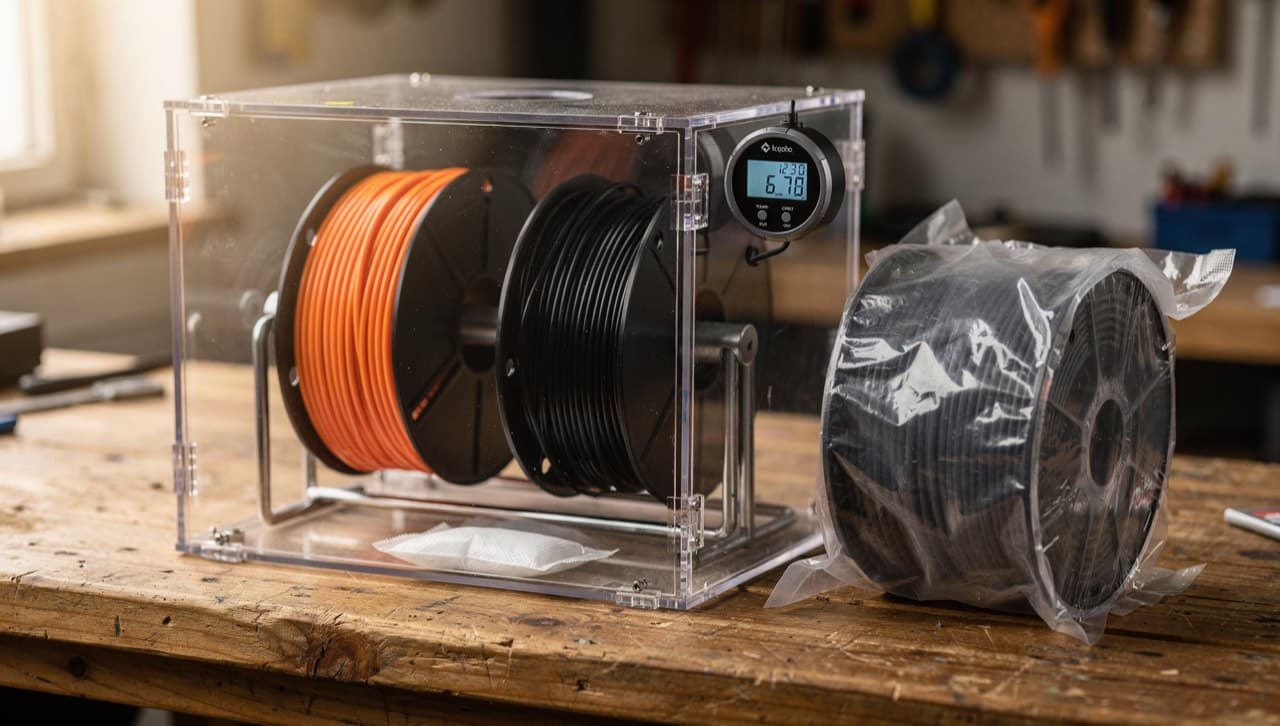
- Working spools (the spool currently in the printer): kept in a sealed dry-box with silica gel desiccant. The dry-box has a hygrometer; we recharge the silica when it reads above 30%.
- Stock spools (not in use): kept in their original vacuum bags with the silica packet that ships with each spool. Sealed and stored in a cupboard.
- Returning a working spool to stock: re-vacuum-seal in a fresh bag with a new silica packet. If you can't vacuum-seal, a freezer bag with the air pushed out and 5–10 g of silica is close enough.
Total cost of the storage rig: about RM 50 for the dry-box, RM 20 for a refillable silica canister, RM 5 for a hygrometer. Pays for itself in not-wasted-filament within a month or two.
If you've left filament out for weeks and you suspect it's wet, the test is: extrude 50 mm by hand from a heated nozzle (200 °C for PLA, 240 °C for PETG). Wet filament hisses or pops. Dry filament extrudes silently. If wet, dry the spool in a food dehydrator at 50 °C for 4–6 hours before printing.
What this means for our customers
The filament choice is upstream of every print decision we make. Our catalog items are designed around the materials we buy reliably — PolyTerra matte PLA in our stock colours, Polymaker PETG for the heat-tolerant items, SUNLU 95A TPU for the flexible parts.
If you want a custom job in a material we don't stock — a specialty PA-CF nylon, a high-temperature PEEK, a transparent SLA resin — we'll be honest about whether we can source it. PA-CF we can run (slow, expensive); PEEK we can't (printer temperature too low); SLA we can't (wrong process entirely; we'll refer you to a resin shop in KL).
For the materials we do run, the materials guide covers when to pick each for a given job.